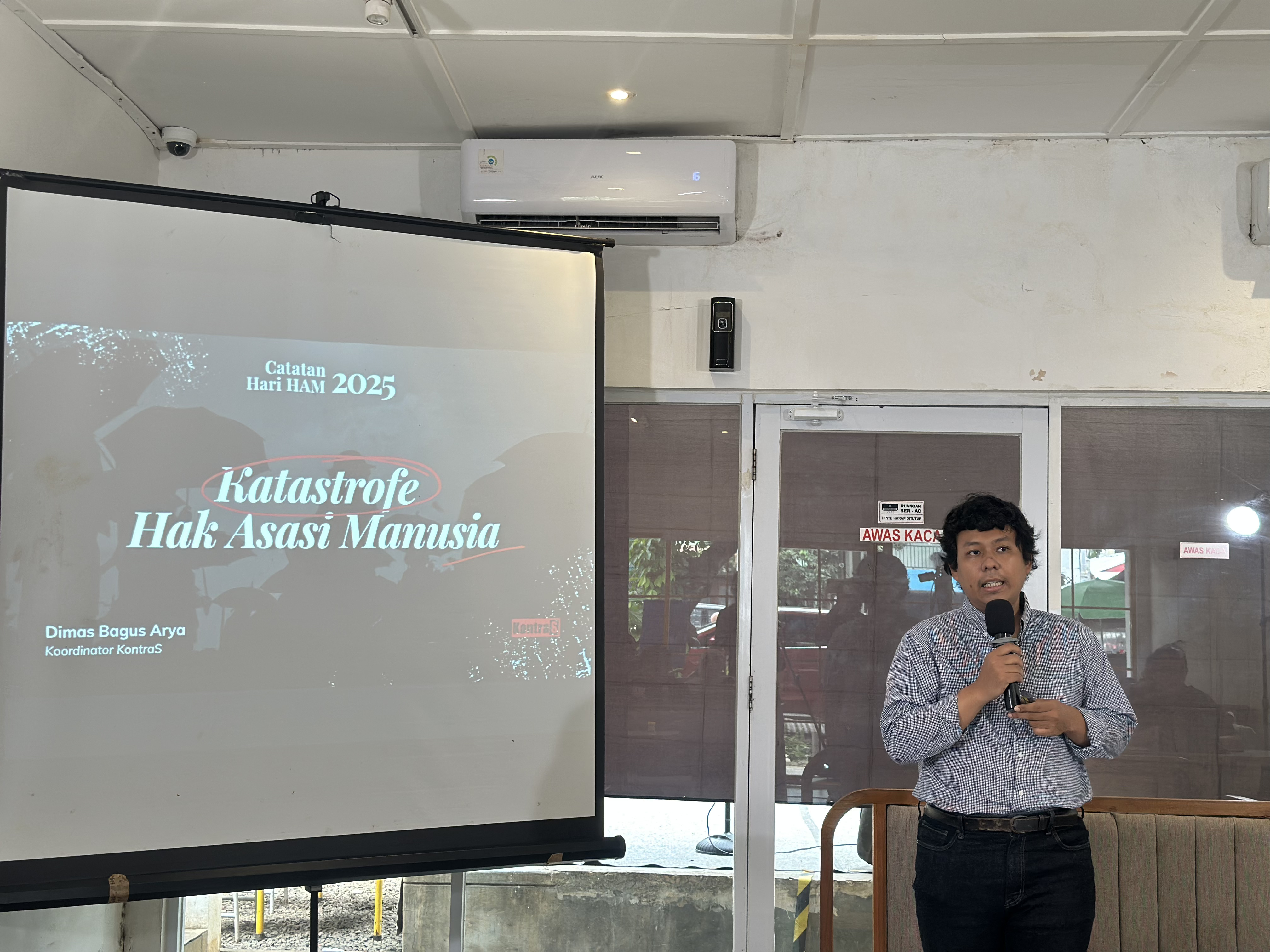
In commemoration of the International Human Rights Day on December 10, the Commission for the Disappeared and Victims of Violence (KontraS) has once again published its Human Rights Day Report. This report summarizes the situation of human rights respect, protection, and fulfillment over the past year. Based on KontraS’ monitoring, the human rights situation in Indonesia throughout 2025 has not shown any significant improvement. In several areas, the situation has even deteriorated or regressed.
The year was marked by the awarding of the title of national hero to Soeharto, a symbol of authoritarianism and the practices of corruption, collusion, and nepotism. This was further exacerbated by public discourse on rewriting Indonesia’s national history in a way that ignores various incidents of gross human rights violations and sidelines the suffering of victims and survivors of those abuses.
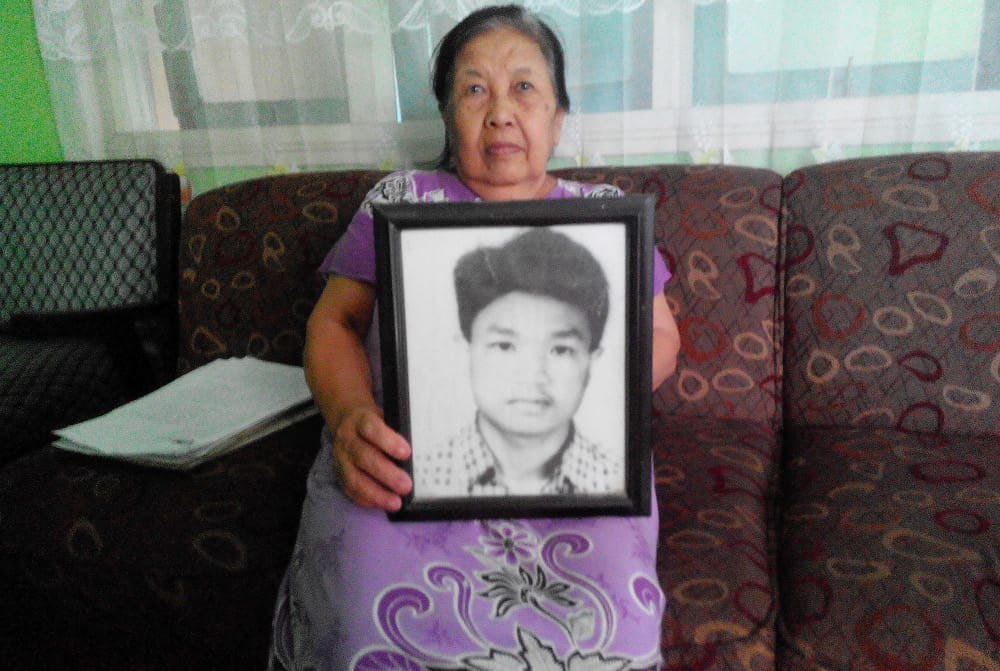
On the other hand, efforts to resolve past gross human rights violations were not the government’s priority this year. For example, during the inauguration of the Rumoh Geudong Memorial Living Park building last July, promoted as an effort to address past human rights abuses in Aceh, the discovery in March 2024 of human remains, strongly believed to belong to victims of the Rumoh Geudong and Pos Sattis killings from 1989 - 1998, appears to have been left to fade away in symbolic memorialization, without any serious state effort toward truth-seeking or justice for these gross human rights violations in Aceh.
The fate of the Paniai gross human rights violation case also remains unclear. Nearly three years after the cassation memorandum was submitted to the Supreme Court, the trial has yet to resume because the Court still lacks ad hoc human rights judges. The families of the Paniai victims continue to be left waiting without any certainty.
In addition, numerous violations of civilians’ fundamental rights have continued throughout 2025. Based on KontraS’s monitoring from December 2024 to November 2025, there were approximately 42 incidents of extrajudicial killings, resulting in 44 deaths. Of these incidents, the National Police (Polri) and the Armed Forces (TNI) were the main actors, responsible for 26 and 15 incidents respectively. These incidents clearly constitute violations of the right to life, a right guaranteed by the Constitution and one that cannot be restricted under any circumstances.
Furthermore, KontraS also recorded 71 incidents of torture during the monitoring period. The most common method of torture this year was beating with bare hands, although in a single incident, victims were often subjected to multiple methods. Other documented methods included kicking, stomping, cutting, and electric shocks. These acts of torture resulted in 159 victims, with 142 people injured and 17 others dying as a result of the torture they experienced.
The National Police (Polri) remains the institution most frequently implicated in acts of torture, responsible for 53 incidents. Five incidents were committed by prison guards in detention centers (Rutan) and correctional facilities (Lapas), and surprisingly, the remaining 13 incidents were committed by members of the TNI. As with the right to life, the right to be free from torture is non-derogable and cannot be restricted under any circumstances. Therefore, each act of torture must be regarded as a serious human rights violation.
In the context of religion and belief, minority groups have repeatedly become victims, despite the Constitution’s explicit guarantee of the right to freedom of religion and belief. Between December 2024 and November 2025, KontraS recorded 32 incidents of violations against freedom of religion and belief, including 14 bans on worship, 9 acts of vandalism, 6 rejections of house-of-worship construction, 4 sealings of houses of worship, 4 acts of intimidation, and 4 acts of persecution.
Furthermore, in the context of civil liberties, KontraS’ monitoring also documented various forms of violations. At least 205 incidents of civil liberty violations occurred, 178 of which were again committed by the National Police (Polri). The TNI was involved in 5 incidents, and government authorities in 14 incidents. These numbers are far from acceptable, as approximately 5,101 people were affected. Among these victims were 661 people injured, 4,291 victims of arbitrary arrest, and 134 victims of other forms of violence, including digital attacks, terror, and intimidation.
During the wave of demonstrations from 25 - 31 August 2025, the KontraS Missing Persons Post received 46 reports of missing persons. Through the result of verification and tracing, KontraS found that 34 of these cases were confirmed as short-term enforced disappearances, while eight cases were due only to miscommunication between victims and those who reported them, and one case remained inconclusive as to whether it involved an enforced disappearance or simple miscommunication.
These incidents occurred because Indonesia’s criminal justice system grants law enforcement agencies excessively broad authority to carry out coercive measures, particularly arrests and detentions.
The year has also marked a troubling turning point in Indonesia’s efforts at security sector reform. The security sector reform agenda, pursued since 1998 with the primary goal of placing the military under civilian supremacy and focusing its role on national defense, has in fact experienced a significant regression. The passage of the revised TNI Law on 20 March 2025 set a dangerous precedent that threatens civilian supremacy and democracy in Indonesia.
The extremely swift process of deliberation and enactment sparked a wave of massive protests and criticism from civil society, academics, and various other societal groups. Nevertheless, these concerns appeared to be ignored by both the Government and the House of Representatives (DPR-RI). In this context, Law No. 3 of 2025, which amends Law No. 34 of 2004 on the Indonesian National Armed Forces (TNI), is considered problematic not only in terms of procedure but also in the substance of the law itself.
Based on the mentioned situations, this year’s Human Rights Day Report is titled “A Human Rights Catastrophe” because various human rights violations continue to recur without adequate evaluation or corrective measures. At the same time, the Indonesian government has shown no serious intention to resolve past gross human rights violations. The Government and the DPR-RI have even fast-tracked the passage of multiple laws, including the TNI Law, without meaningful public participation.
This report is intended to serve as a reference for the public in understanding the human rights dynamics and developments over the past year. It is also hoped that the report will serve as a basis for evaluating and improving the policies and responses related to the many human rights violations that have taken place.
Jakarta, 9 December 2025
Dimas Bagus Arya
Coordinator of KontraS
KontraS
Komisi Untuk Orang Hilang dan Korban Tindak Kekerasan