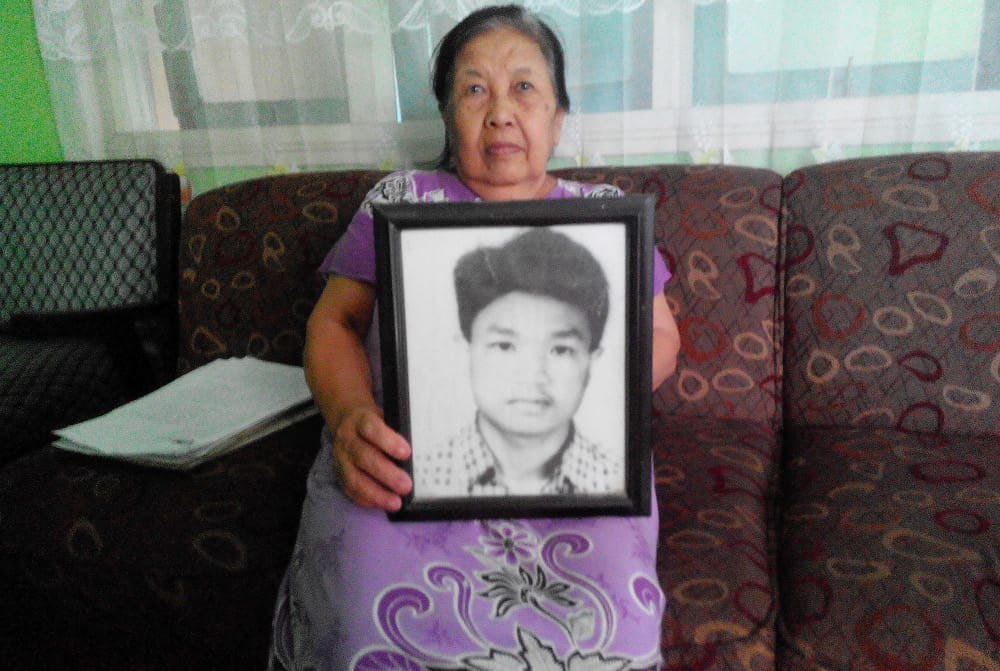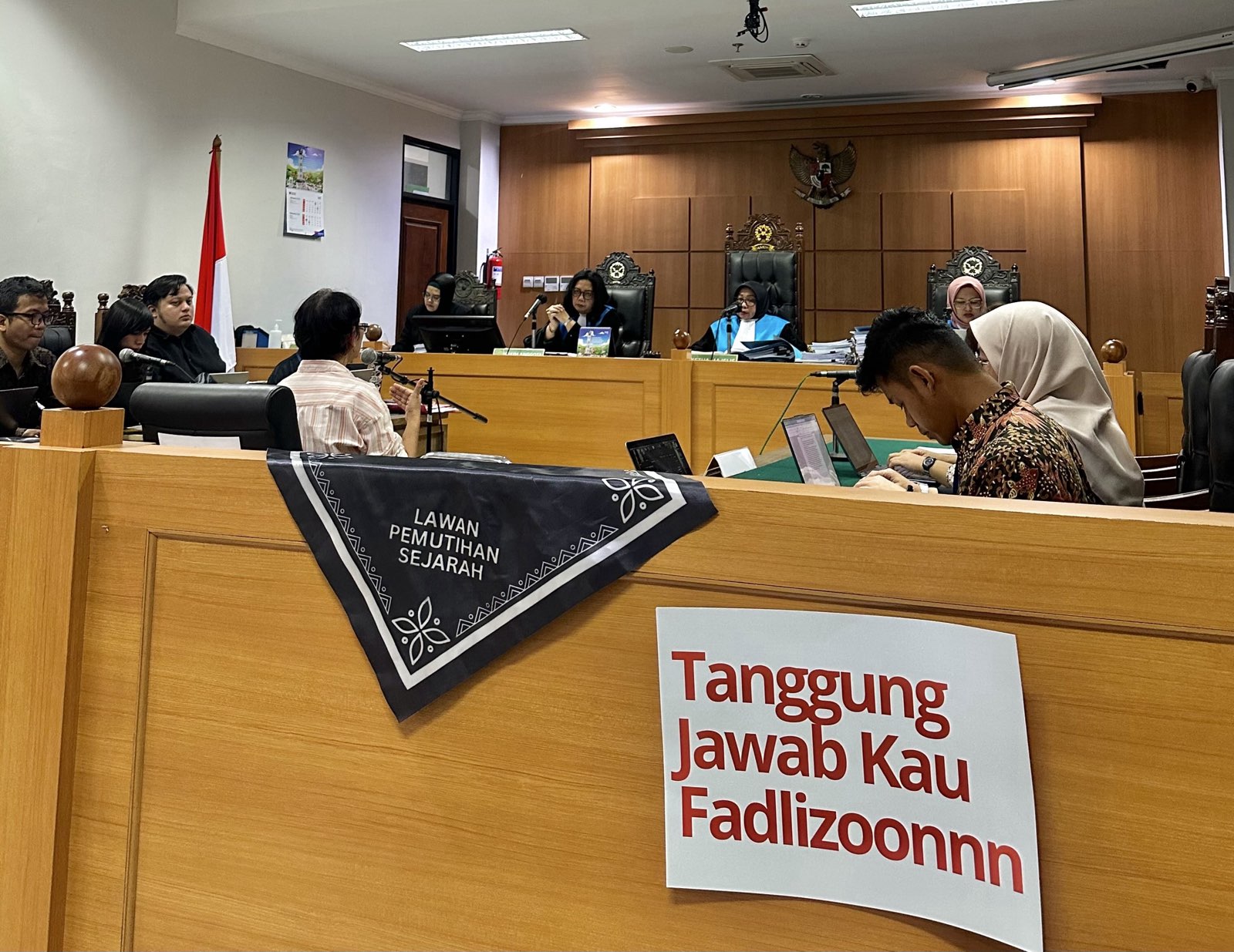
On Thursday, 15 January 2026, the Civil Society Coalition Against Impunity which consists of the Indonesian Legal Aid Foundation (YLBHI), Kalyanamitra, the Indonesian Chinese Youth Association (IPTI), as well as family members of victims of the 1998 May Gross Human Rights Violations attended a hearing at the Jakarta State Administrative Court (PTUN). The lawsuit was filed in response to a public statement by the Indonesian Minister of Culture, Fadli Zon where he denied the occurrence of mass rapes during the May 1998 Tragedy, as recorded in Case No. 335/G/TF/2025/PTUN.JKT.
The agenda of this hearing included the examination of testimonies from witness Sri Palupi, a member of the Assistance Team of the Joint Fact-Finding Team (TGPF) and an expert in State Administrative Law, Dr. W. Riawan Tjandra, S.H., M.Hum. and a psychology expert, Livia Istania DF, Iskandar, M.Sc., Psychologist, all of whom were presented by the applicant.
Before the panel of judges, Sri Palupi who in 1998 served as a member of the Assistance Team of the Joint Fact-Finding Team (TGPF), presented key findings regarding the truth of the mass rapes of May 1998, which had been denied by the Minister of Culture, Fadli Zon. She recounted how she and other members of the TGPF, which had been formally established by the State, collected direct testimonies from victims, victims’ families, medical personnel, religious and psychological counsellors, and other witnesses.
At the time, Sri Palupi was involved in investigative and verification work concerning the large number of reports of sexual violence received. She emphasized that the mass rapes that occurred were not random criminal acts but demonstrated similar patterns across different locations. “Within both the Volunteer Team for Humanity (TRK) and the TGPF, we found extensive reports and data on mass rapes. According to the TGPF, the forms of sexual violence documented during the May 1998 unrest can be categorized into several types: rape, rape accompanied by assault, sexual assault/physical abuse, and sexual harassment.”
As a witness, Sri Palupi explained the profound trauma experienced, as well as the terror, threats, and intimidation that targeted not only the victims and their families but also those who supported them, including members of the TGPF. These conditions created significant obstacles in verifying data on victims of the mass rapes at the time. Sri Palupi elaborated not only factual information about the systematic patterns of violence and terror, but also brought forward the voices of victims who, for decades, had been silenced by stigma and the State’s neglect.
Aside from Sri Palupi, psychology expert Livia Istania DF, Iskandar, M.Sc., Psychologist, also stated that the impact of rape on survivors not only transforms their perception of the world but shatters their lives, erodes their sense of trust, and is further exacerbated by stigma and victim-blaming. The expert emphasized that the absence of formal legal reports at the time must not be interpreted as evidence that the violence did not occur but rather should be understood as a manifestation of collective trauma and self-protective mechanisms, in which survivors experienced psychological paralysis not only as a result of the sexual violence itself but also due to systematic terror.
According to the expert, when a public official makes an open statement denying the occurrence of rape, particularly mass rape during the May 1998 tragedy, it effectively destroys the fragile threads of recovery and the wounds that have never healed. “...It does not only cause harm; it destroys what has been painstakingly built over decades to support trauma recovery… Post-traumatic stress symptoms can last a lifetime, and survivors may experience re-victimization.” Such denial by a public official constitutes a form of institutional gaslighting that can trigger retraumatization, forcing survivors to confront a reality in which their suffering is erased from the nation’s historical narrative, ultimately undermining the social contract and the broader community’s sense of psychological safety.
Meanwhile, Dr. W. Riawan Tjandra, an expert in State Administrative Law, explained that the public statement made by the Indonesian Minister of Culture which is the object of the lawsuit, constitutes a factual administrative act and clearly exceeds the authority vested in him as Minister of Culture. “Categorically, the Respondent’s action is classified as actus factici administrationis (emphasizing a factual act by the state administration),” he stated.
He elaborated that pursuant to Article 1(8) in conjunction with Article 87(1) of Law No. 30/2014 on Government Administration, and Article 1(1) of Supreme Court Regulation No. 2/2019 on Guidelines for Resolving Disputes Concerning Government Actions and Jurisdiction Over Unlawful Acts by Government Bodies and/or Officials (Onrechtmatige Overheidsdaad), a statement made by a government official must meet the following criteria:
-
It is conveyed in the official capacity of a government administrative official;
-
It is delivered through an official channel of the government body/official;
-
It constitutes the expression of intent (manifestatio voluntatis) of the government administrative official;
-
It can be proven.
He further explained that manifestations of intent fall into two categories:
-
expressio voluntatis (expression of intent); and/or
-
actus voluntatis (act of intent).
According to the Expert, Fadli Zon’s actions as the Minister of Culture clearly fulfill both categories, namely a factual and active administrative act through statements made as expressio voluntatis (expression of intent) and actus voluntatis (act of intent). These statements were disseminated through the Ministry of Culture’s Press Release No. 151/Sipers/A4/HM.00.005/2025 dated 16 May 2025 (published on 16 June 2025), as well as through the official Instagram account of the Minister, @fadlizon, and the official Instagram account of the Ministry of Culture, @kemenkebud, on 16 June 2025.
Based on the testimony delivered by the State Administrative Law Expert during the hearing, the statements made by Fadli Zon as an administrative official clearly have the potential to cause non-material harm, such as loss of trust (amissio fiduciae), including perdita fiduciae (loss of trust) and/or defectus fiduciae (erosion/deterioration of trust), as well as tangible social unrest (tumultus socialis manifestus), which may manifest in two forms: perturbatio socialis manifesta (actual social disruption) and/or commotio socialis realis (real social turmoil).
The expert also stated that the challenged administrative act namely the denial of data and findings issued by an official State body regarding the May 1998 mass rapes, clearly exceeds the scope of authority of the Ministry of Culture. “...Thus, there is a danger if the statement referred to in the object of the lawsuit is not revoked, as it may set a precedent that becomes legitimized through governmental administrative practice, an extremely dangerous development if it is allowed to stand as a source of administrative law that justifies such actions.”
From the trial proceedings and the testimonies of witnesses and experts presented by the Plaintiffs, it is evident that the contested administrative act in question, carried out by Fadli Zon, constitutes an act of government administration that clearly violates multiple statutory regulations, the Principles of Good Governance (AUPB), and Human Rights, and demonstrates an abuse of the authority vested in him as the Minister of Culture.
Accordingly, the Jakarta State Administrative Court (PTUN) should declare that the contested act constitutes an unlawful act by a government body and/or official, and order Fadli Zon, as the Respondent, to fully retract the statement that forms the object of the lawsuit.
What Fadli Zon has done is not only an overreach of authority, but also an act that has caused profound harm to the victims and families of victims of the May 1998 events. His actions represent a clear attempt to distort historical truth and constitute an affront to efforts to uncover the facts surrounding the crimes against humanity that occurred, particularly the acts of sexual violence against women during the May 1998 events.
Jakarta, 15 January 2026
Civil Society Coalition Against Impunity.
KontraS
Komisi Untuk Orang Hilang dan Korban Tindak Kekerasan