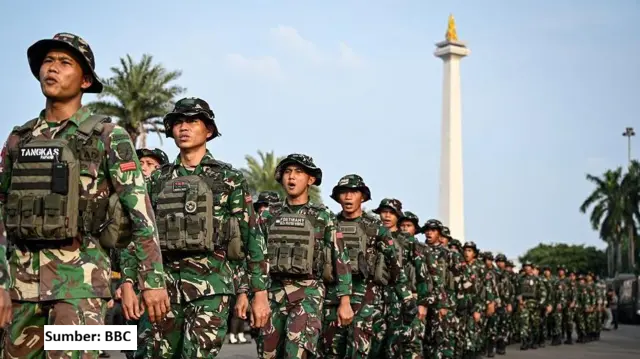
A draft of Presidential Regulation on the Role of the Indonesian National Armed Forces (TNI) in Counterterrorism is currently circulating in the public domain. The draft regulation is expected to be submitted to the House of Representatives (DPR) for consultation in the near future in order to obtain its approval.
This process is in line with the explanation of Article 43I paragraph (3) of Law No. 5 of 2018, which amended Law No. 15 of 2003 on the Stipulation of Government Regulation in Lieu of Law No. 1 of 2002 on the Eradication of Criminal Acts of Terrorism into Law, stating that “The formulation of a presidential regulation under this provision shall be carried out after consultation with the House of Representatives of the Republic of Indonesia.”
The Coalition considers the draft to be problematic both formally and substantively. From a formal legal perspective, the provision governing TNI involvement through a Presidential Regulation, namely Article 43I of Law No. 5 of 2018 which is fundamentally inconsistent with Article 4 of People’s Consultative Assembly (MPR) Decree No. VII of 2000, that explicitly stipulates that any assistance provided by the TNI in security-related tasks must be regulated by law. This requirement is further reaffirmed in Article 7 paragraph (2) letter (b) point (10) of the TNI Law. Therefore, regulating the involvement of the TNI in addressing terrorism-related criminal acts through a Presidential Regulation is erroneous and unconstitutional.
From a substantive perspective, the Coalition considers the Presidential Regulation draft on the Role of the TNI in Addressing Acts of Terrorism to pose serious risks to democracy, human rights, and the rule of law. The broad and vaguely defined powers granted to the TNI create significant space for abuse beyond the legitimate objective of counterterrorism. The draft also risks encouraging the practice of labeling critical segments of society as “terrorists,” thereby constituting a serious threat to civil society movements, including students and workers. This concern is further heightened by President Prabowo Subianto’s statement in late August 2025, in which he identified protesting student groups as terrorist groups. In this context, the draft Presidential Regulation serves as an affirmation of the regime’s expanding authority to construct
The circulating draft reveals an excessive and overly elastic expansion of the TNI’s role. This is evident in the regulation of military functions in addressing acts of terrorism, which encompass prevention, enforcement, and recovery functions (Article 2 paragraph 2). The implementation of the prevention function includes a wide range of activities, such as intelligence, territorial, and information operations, as well as “other operations” (Article 3), which are formulated without adequate explanation. The phrase “other operations” is highly vague and open to multiple interpretations, thereby creating significant potential for misuse for political purposes and posing serious threats to civil liberties and democratic governance.
The Coalition also underlines that the TNI should not be involved in prevention and recovery functions, as its primary role is that of a national defense force rather than a law enforcement body. Such functions should instead be carried out by competent and authorized civilian institutions, including the State Intelligence Agency (BIN) for prevention, and the Ministry of Religious Affairs, the Ministry of Education, the National Counterterrorism Agency (BNPT), as well as other relevant ministries and institutions for recovery efforts, including reconstruction and rehabilitation.
The role of the TNI should be strictly limited to providing assistance in counterterrorism enforcement only in situations where terrorism poses a direct threat to state sovereignty. Any deployment in support of civilian security forces (law enforcement agencies) must be carried out solely under exceptional or emergency circumstances, as a measure of last resort, and based on a Presidential Decision. Granting the TNI autonomous authority over prevention and enforcement functions risks creating overlapping mandates with civilian law enforcement bodies, endangering human rights, and contravening Article 30 of the 1945 Constitution.
Moreover, the term “deterrence” is not recognized under the Law on the Eradication of Criminal Acts of Terrorism. The law only recognizes the concept of “prevention” (Chapter VIIA of the Counterterrorism Law), which is defined as a responsibility of the government and coordinated by the BNPT in cooperation with relevant ministries and institutions (General Elucidation of the Counterterrorism Law). The implementation of prevention measures is to be regulated through a Government Regulation, as stipulated in Articles 43B, 43C, and 43D of the Counterterrorism Law, rather than through a Presidential Regulation.
Preventive authority should also not be granted to the TNI, as such authority falls outside the scope of the TNI’s core mandate as regulated under the TNI Law and would create overlapping responsibilities with other institutions tasked with prevention, including the Ministry of Education, the Ministry of Religious Affairs, and other bodies coordinated by BNPT. Therefore, granting preventive authority to the TNI under the draft Presidential Regulation is unnecessary and, moreover, contradicts the Counterterrorism Law.
The Coalition also highlights serious concerns regarding transparency and accountability in law enforcement within the TNI. Should human rights violations occur in the course of preventive or enforcement operations, legal accountability would be difficult to ensure given the unresolved agenda of military justice reform. This reform is, in fact, mandated both by People’s Consultative Assembly (MPR) Decree No. VII of 2000 and by the TNI Law itself.
Therefore, if the TNI is to be involved in domestic counterterrorism enforcement, the Presidential Regulation must explicitly stipulate that TNI personnel are subject to the jurisdiction of civilian courts, and this must be accompanied by concrete steps taken by the President to revise the Military Court Law. Granting broad powers to the TNI without adequate accountability mechanisms amounts to a highly dangerous blank check that threatens human rights, the rule of law, and democracy.
The Coalition considers that the Presidential Regulation draft has the potential to create serious problems for law enforcement and the protection of human rights in Indonesia. Under the pretext of counterterrorism, the TNI, an institution that is not a law enforcement body, is granted authority to conduct direct enforcement operations within the country. In principle, the military is trained to engage in warfare, not to perform law enforcement functions. Granting the TNI direct authority to carry out counterterrorism enforcement risks undermining the criminal justice system, as regulated under the Counterterrorism Law and the Criminal Procedure Code (KUHAP), thereby increasing the risk of human rights violations.
Military involvement in addressing terrorism should be strictly limited to responding to terrorist threats abroad, such as the hijacking of Indonesian vessels or aircraft overseas, or operations to rescue Indonesian nationals abroad. The military should not be granted preventive or enforcement powers to directly address terrorism within the country, as provided for in the draft Presidential Regulation. The handling of domestic terrorism must remain within the framework of the criminal justice system.
On this basis, the Civil Society Coalition for Security Sector Reform:
-
Rejects the Presidential Regulation draft on the involvement of the TNI in addressing acts of terrorism, as it poses serious dangers to democratic life, the rule of law, and the enforcement of human rights;
-
Calls on all parliamentary factions in the House of Representatives (DPR) to reject the draft Presidential Regulation on TNI involvement in counterterrorism, due to its serious formal and substantive deficiencies;
-
Urges President Prabowo Subianto to withdraw and comprehensively review the draft Presidential Regulation, as it endangers democratic governance and the future of human rights protection in Indonesia.
Jakarta, 7 January 2026
The Civil Society Coalition for the Security Sector Reform
Imparsial, KontraS, YLBHI, Centra Initiative, Raksha Initiatives, DeJure, PBHI, HRWG, Amnesty International Indonesia, Setara Institute, LBH Pers, WALHI, ICJR, LBH Jakarta, Koalisi Perempuan Indonesia, Pusat Studi Konstitusi (PUSAKO) Universitas Andalas, PUSHAM Universitas Negeri Medan, Pusat Pengembangan Hak Asasi Manusia dan Demokrasi (PPHD) Universitas Brawijaya, LBH Surabaya Pos Malang, AJI Indonesia, AJI Jakarta
Contact Persons :
- Ardi Manto Adiputra (Director of Imparsial)
- Muhammad Isnur (Coordinator of YLBHI)
- Julius Ibrani (Coordinator of PBHI)
- Al Araf (Coordinator of Centra Initiative)
- Wahyudi Djafar (Director of Raksha Initiatives)
- Daniel Awigra (Director of HRWG)
- Dimas Bagus Arya (Coordinator of Kontras)
- Usman Hamid (Director of Amnesty International Indonesia)
KontraS
Komisi Untuk Orang Hilang dan Korban Tindak Kekerasan