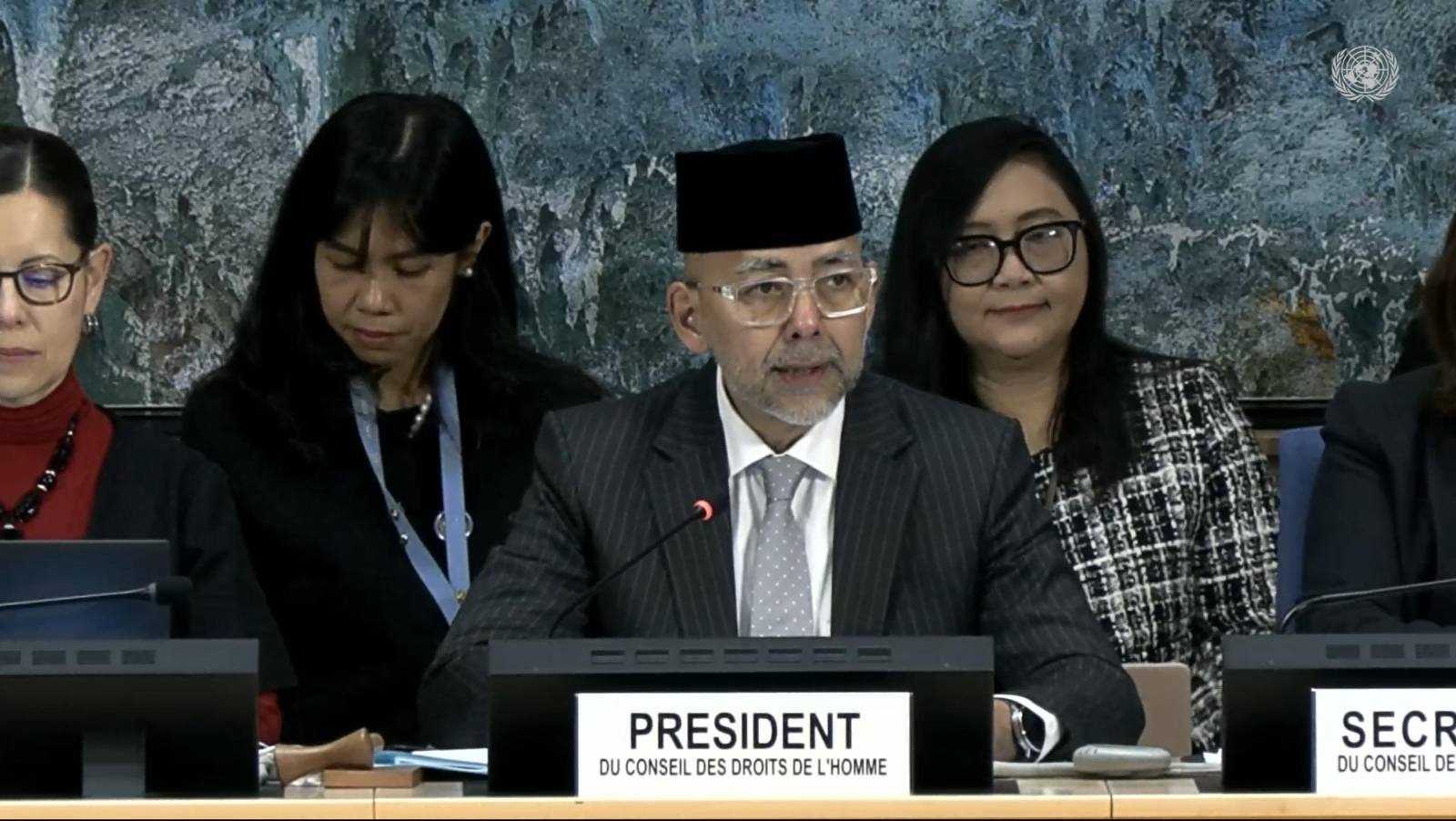
Indonesia has been appointed President of the UN Human Rights Council in Geneva. On the surface, this moment may be seen as a diplomatic achievement and a reflection of global confidence, particularly from the Asia-Pacific region, which delivered 34 out of 47 votes from the Asia-Pacific Group (APG). Yet, at the same time, this position intensifies scrutiny of Indonesia’s selective silence on a wide range of human rights issues, both domestically and in humanitarian crises at the regional and global levels.
Beyond mere prestige, the presidency of the UN Human Rights Council carries substantive mandates, including facilitating open human rights dialogue, ensuring meaningful civil society participation, and promoting the protection of human rights defenders. In this context, a fundamental question arises: has Indonesia demonstrated practices consistent with these mandates within its own borders?
Rather than facilitating dialogue, the way public demands are addressed in Indonesia has instead tended to delegitimize critical voices, resulting in the erosion of civic space. A series of protests throughout 2025 from the ‘Indonesia Gelap’ demonstrations in February, the March 2025 protests against the revision of the Military Law, the May Day mobilizations in May, to the unrest during the 25-31 August 2025 protests, were met with repressive actions by security forces.
Injuries, casualties, and the criminalization of protesters have continued to occur, yet none of the public demands have been addressed. Moreover, the government’s official statement “Indonesia Gelap (Dark), you are the ones in the dark” illustrates a defensive posture toward criticism rather than a willingness to listen and engage in dialogue.
This situation raises serious doubts about Indonesia’s eligibility to hold the presidency of the UN Human Rights Council. A forum that normatively places dialogue and participation at the core of its work is, paradoxically, being led by a state that routinely disregards public aspirations and criminalizes expression and protest within its own civic space.
Furthermore, with regard to the state’s function in protecting human rights defenders, it has instead exhibited a pattern of criminalizing civil society advocacy. The rejection of the proposal to grant Soeharto the title of national hero, for instance, was met not with open dialogue but with exclusion and stigmatization.
A similar pattern is evident in the practice of red-tagging against youth, activists, and civil society groups who have long voiced social, economic, and democratic concerns. Another persistent issue is the state’s slow response in addressing acts of terror targeting human rights defenders, such as the delivery of a pig’s head and dead rats to Tempo journalists, and the molotov cocktail attack on the Jubi news office. This lack of accountability has enabled the recurrence of similar attacks toward the end of 2025, including the incident targeting Iqbal Damanik, a Greenpeace Indonesia activist.
The Indonesian government has also frequently concealed the worsening human rights situation in Papua. Instead of ensuring the fulfillment of basic services, the State has chosen to employ security-based approaches by deploying military forces without clear legal authorization. This has led to an escalation of conflict which, in many cases, results in violence and human rights violations, causing both material and immaterial harm to Indigenous Papuans. These impacts include land dispossession, the illegal occupation of public facilities such as schools and health centers as military posts, and repressive actions against Indigenous communities. Such conduct further underscores Indonesia’s selective silence in confronting serious violations within its own territory, while simultaneously weakening its claim to be a credible actor in leading the global human rights agenda.
This tendency toward selective silence does not stand alone, it is intertwined with Indonesia’s increasingly regressive human rights diplomacy on the issue of Palestine. On one hand, Indonesia continues to present itself as a steadfast supporter of the Palestinian struggle across international forums. Yet on the other hand, its practices of solidarity reveal sharp contradictions between political statements, international legal commitments, and economic activities that ultimately benefit the Israeli occupying authority.
This contradiction became particularly evident following the statement of Indonesia’s Deputy Minister of Foreign Affairs, Anis Matta, during the Extraordinary Session of the Organisation of Islamic Cooperation (OIC) in Riyadh in November 2024. In that forum, Indonesia explicitly called on OIC member states to sever economic and trade relations with Israel as a concrete measure to halt the aggression and support the Palestinian people. However, this call was never translated into actual policy at the national level.
At a time when the Indonesian government should have halted economic relations, trade flows with Israel continued uninterrupted. Data from Statistics Indonesia (BPS) show that between January and May 2025, Indonesia recorded imports from Israel amounting to USD 13,187,366 and exports totaling USD 83,634,839. These transactions resulted in a trade surplus of USD 70,447,473 for Indonesia, equivalent to approximately IDR 1,377,432,006,840.75. This reality strongly demonstrates that national economic gains were prioritized, even when such relations directly benefited a state currently maintaining an occupation and apartheid system against the Palestinian people.
Indonesia’s regressing human rights diplomacy on the issue of Palestine is further reflected in political signals that blur the principle of non-recognition toward Israel. Beginning in May 2025, President Prabowo Subianto publicly stated that Indonesia might recognize Israel should the entity first recognize the State of Palestine. Such a statement stands in clear contradiction to the principle of non-recognition under international law, particularly after the International Court of Justice affirmed in July 2024 that Israel’s occupation of Palestinian territory is illegal. As a result, this discourse of “conditional recognition” opens the door to normalization and impunity for Israel’s crimes against humanity, while simultaneously eroding Indonesia’s longstanding position as a consistent supporter of the Palestinian struggle.
These practices cannot be separated from the obligations under international law reaffirmed by the International Court of Justice (ICJ) in its July 2024 advisory opinion, which stated that Israel’s occupation of Palestinian territory since 1967 is illegal and underscored the duty of third states not to recognize, aid, or assist in maintaining such an unlawful situation. Within this legal framework, trade relations that generate economic benefit for Israel cannot be regarded as neutral; rather, they risk constituting complicity or indirect involvement in violations of international law.
Concerns over the direction of Indonesia’s foreign policy further intensified with its support for UN Security Council Resolution 2803, which risks normalizing a new form of foreign occupation over Gaza and disregarding the Palestinian people’s right to self-determination. The resolution reiterates that third states, including Indonesia, have an international legal obligation not to assist or contribute to the maintenance of Israel’s illegal occupation.
In this context, Indonesia’s leadership of the UN Human Rights Council can no longer be questioned merely on moral grounds, but also on normative and legal ones. When a state calls for economic sanctions in multilateral forums while simultaneously maintaining trade relations that benefit an illegal occupying power, its human rights diplomacy inevitably loses credibility. The presidency of the Human Rights Council demands consistency between principles, practice, and a clear commitment to victims, something that Indonesia has yet to demonstrate in its policies toward Palestine.
The irony deepens when the government, through the Ministry of Foreign Affairs on 23 December 2025 as well as in its inauguration on 8 January 2026 in Geneva, emphasized Indonesia’s role as a “bridge builder” and an “objective and balanced” actor. In the human rights context, however, such pseudo-neutrality and excessive caution often result in the abdication of moral responsibility. The UN Human Rights Council was not established merely to maintain political equilibrium among states, but to ensure that human rights violations, wherever they occur, are met with courage, clarity, and a commitment to those affected.
Indonesia’s 2026 presidency of the Human Rights Council, which coincides with the body’s 20th anniversary, should serve as a turning point. Indonesia has an opportunity to prove that human rights leadership is not simply a matter of diplomatic prestige, but of value consistency, principled advocacy, and genuine political will to place human rights above narrow state interests. Without critical reflection and concrete action, the presidency risks becoming an empty symbol that offers no meaningful contribution to democratic life at home.
Jakarta, 8 January 2026
Dimas Bagus Arya
KontraS Coordinator
Tags
KontraS
Komisi Untuk Orang Hilang dan Korban Tindak Kekerasan